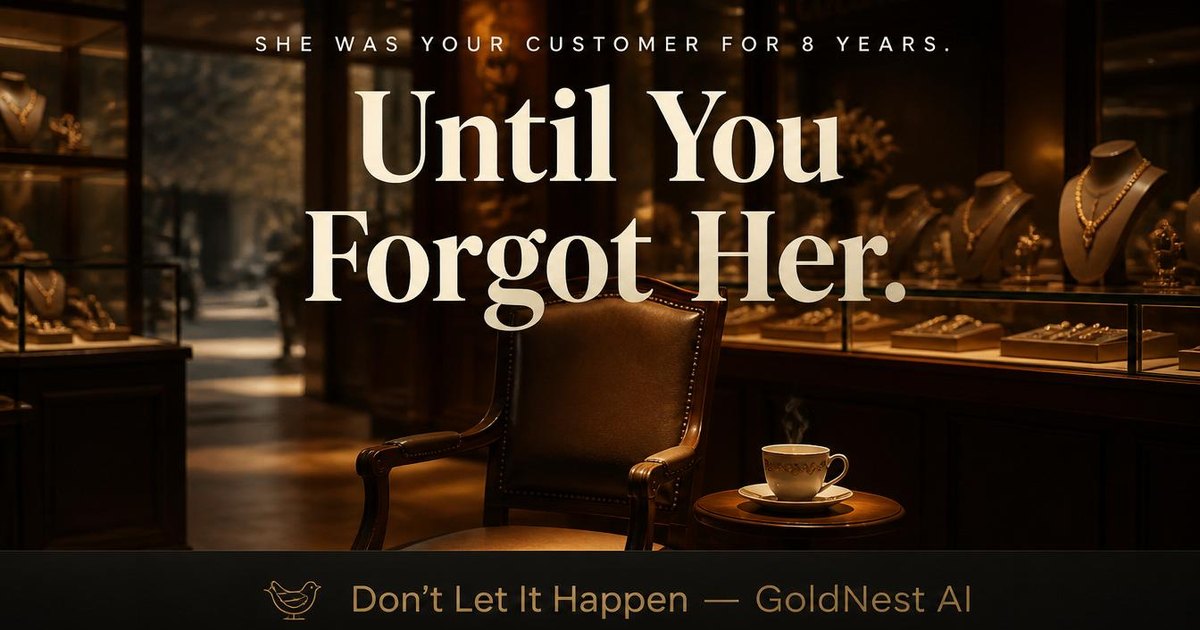
She Didn't Leave Your Store. You Left Her. And You Never Noticed.
Her name was Mrs. Al Mansouri.
She had been coming to the same jewellery shop in Deira for nine years. Every Eid, something for her daughters. Every anniversary, something for herself. When her eldest got engaged, she came in and spent an afternoon — tea, conversation, three pieces tried and one chosen. The jeweller knew her name. Knew her taste. Knew that she preferred 22K over 18K and never bought anything with coloured stones.
Then, two years ago, she stopped coming.
The jeweller assumed she had moved. Or found someone closer to her new neighbourhood. Or simply changed where she shopped, the way people sometimes do.
The truth was simpler and more uncomfortable.
Nothing had changed. She had not moved, had not been disappointed, had not found a better jeweller. She had simply drifted — quietly, without drama, without a moment of decision — because nothing had ever reminded her to come back.
Customers don't leave jewellery businesses dramatically. They drift. And drifting is silent — you never see it happening until it's already done.
How Nine Years Becomes Zero
The jeweller in Deira lost not just one customer. He lost the daughter's future purchases, the referrals to her friends, the decades of continued relationship that would have followed. He lost it because he was present for nine years and then absent for one critical moment.
The Numbers Behind the Story
These are not aspirational benchmarks. They are consistent findings across retail research — and they describe a structural reality that most jewellery businesses are not currently built to take advantage of.
What Drifting Actually Looks Like — Step by Step
The Fix Is Not Complicated
This is not a story about technology. It is a story about consistency.
The jewellers who keep customers like Mrs. Al Mansouri for decades are not doing anything exotic. They are simply doing one thing: showing up at the right moments between purchases. A message before Eid. A note when a price correction makes that piece she was watching affordable. A reminder when her daughter's next milestone approaches.
The challenge is not knowing what to do. It is doing it consistently, across hundreds of customers, without dropping anyone.
What the system looks like in practice
A customer who hasn't purchased in six months receives a personal touchpoint — not a generic broadcast, a message that references something specific about their history with you. A customer whose daughter got engaged two years ago gets a gentle note as the wedding season approaches. A customer who asked about a piece and didn't buy gets a message when the price moves in their favour. One message. One moment. Often, that is enough to bring someone back who would otherwise have drifted permanently.
Why Most Jewellery Businesses Don't Do This
It is not because they don't care. Mrs. Al Mansouri's jeweller cared about her enormously. He still thinks about her when her name comes up.
It is because doing this consistently — across two hundred or five hundred customers, tracking the right moment for each, remembering what matters to each person — is simply beyond what human memory and manual effort can sustain. It falls through the cracks not through negligence but through the natural limits of an unassisted system.
The businesses that solve this problem are the ones that build a system around it — something that tracks customers, flags when follow-up is due, and surfaces the right moment to reach out before it passes.