UAE Jewellery Demand Has Hit a Six-Year Low. The Jewellers Who Are Growing Anyway Are Doing One Thing Differently.
The World Gold Council's Q2 2026 report arrived with a number that most jewellers in Dubai already felt — they just hadn't seen it written down.
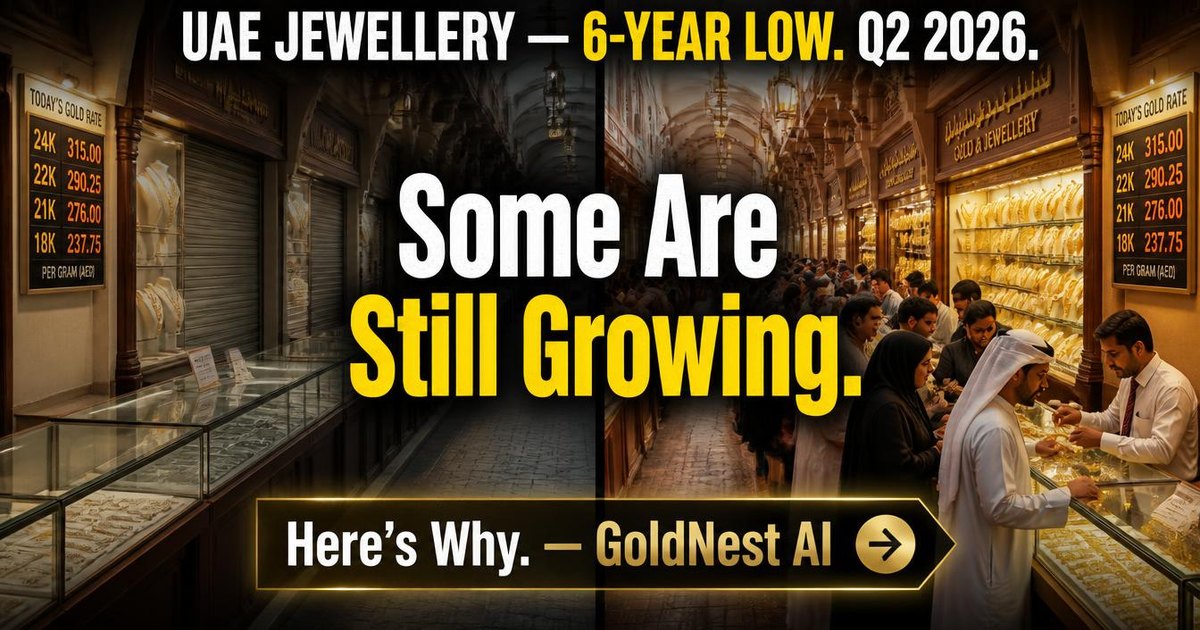
Jewellery demand fell to its lowest quarterly volume since the pandemic — 278 tonnes globally. In the UAE, the market recorded its 14th consecutive quarterly year-on-year decline, making it one of the few markets globally to see a year-on-year drop even in US dollar value terms.
Fourteen consecutive quarters. Three and a half years of contraction.
The reasons are real and compounding. High gold prices and broader inflationary pressures continued to constrain affordability. US-Iran conflict weighed on tourist arrivals — a significant source of jewellery demand for the UAE. Spot gold fell from its January high of $5,595 per ounce to around $4,000 by late June — a 28 percent pullback — but not enough to trigger the buying response the market needed.
And yet, within this contracting market, some independent jewellers in Dubai and Abu Dhabi are holding revenue. Some are growing.
They are not doing it with lower prices. They are not doing it with new products or better locations. The difference is simpler and more uncomfortable to acknowledge.
The jewellers who are growing in a down market are not winning new customers. They are keeping the ones they already have — systematically, consistently, and before those customers start looking elsewhere.
What the Numbers Actually Say
There is an important nuance buried in the same report. While jewellery demand remained weak, investment demand in the region proved more resilient. The UAE gained some support from lower prices and Indian expatriate demand — which will likely be boosted during the rest of the year as India's import duty hike affords the region a price advantage.
This matters for jewellers. The money is not leaving the gold market. It is moving from jewellery into bars and coins. Customers who previously bought a necklace are now buying a 10-gram bar. The spending intent is there — the form it takes has changed.
The jewellers who understand this shift are adjusting their conversations. The ones who haven't are experiencing the full weight of the volume decline.
The Market by Segment — What Is Actually Happening
| Segment | Direction — Q2 2026 | What's Driving It |
|---|---|---|
| UAE Jewellery Retail | ↓ 14th consecutive decline | High prices, fewer tourists, inflation pressure |
| UAE Investment (Bars & Coins) | ↑ Resilient | Geopolitical uncertainty, safe haven demand |
| Indian Expatriate Demand | ↑ Growing | India import duty hike makes UAE gold cheaper by comparison |
| Tourist-Driven Demand | ↓ Declined | US-Iran conflict reduced tourist arrivals to Dubai |
| H2 2026 Outlook | Cautiously improving | Festive season, potential price correction, Indian expat buying |
How Customers Actually Leave — And Why It Is Silent
The conversation about declining demand tends to focus on macro factors — gold prices, tourist numbers, inflation. These are real. But there is a customer-level story that explains a significant portion of the decline that macro analysis does not capture.
Customers don't leave jewellery businesses dramatically. They drift.
In a growing market, this attrition is masked by new customer acquisition. In a market that has been contracting for fourteen consecutive quarters, it is fully exposed.
The Two Types of Jewellers in This Market Right Now
Losing ground
- Wait for walk-in traffic to return
- No systematic follow-up with existing customers
- Customer history lives in staff memory
- Invisible between purchases
- Compete on price when challenged
- Surprised when good customers stop coming
Holding and growing
- Proactively reach customers before buying moments
- Every customer has a follow-up timeline
- Customer history is recorded and used
- Stay present between purchases
- Compete on relationship, not price
- Know when a customer goes quiet — and act
The difference between these two groups is not talent, not product quality, not even location. It is whether the business has a system that keeps it connected to its customers between transactions.
What That System Looks Like in Practice
The H2 2026 Opportunity
The World Gold Council expects investment demand to remain the primary source of demand growth for the remainder of 2026, with festive and wedding-related purchases expected to provide support through the second half of the year.
Indian expatriate demand — a meaningful segment for UAE jewellers — is likely to be boosted as India's import duty hike makes UAE-sourced gold comparatively more attractive.
This means the second half is not uniformly bleak. There are identifiable segments that will buy. The question is whether your business is positioned to reach those segments before your competitors do — and whether the customers who trust you already know you are there.
The jewellers who will capture H2 demand are the ones who have spent H1 staying connected to the customers they already had. The ones who are only now thinking about customer outreach will be building those relationships from scratch during the same period their competitors are harvesting theirs.